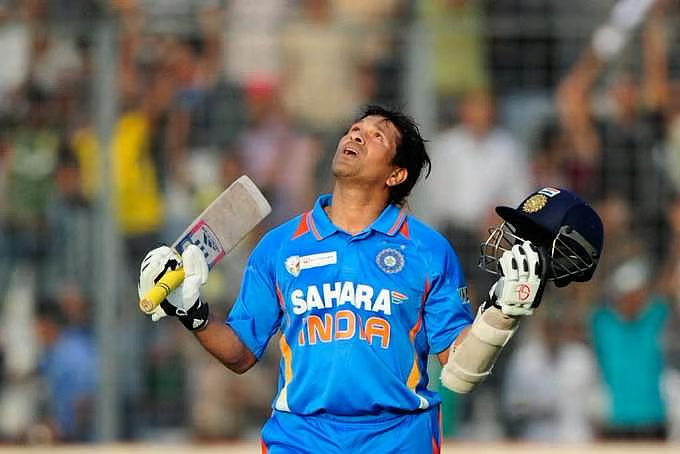
Sachin Tendulkar turns 53 today, carrying a record that even decades of anniversary writing have struggled to capture in full depth. His 100 international centuries are often presented as a glittering, almost symbolic milestone — a round number celebrated as a cricketing monument. But a closer reading reveals something far more demanding and layered: a sustained output spread across 21 years, seven months, and seven days, stretching from his first international hundred in August 1990 to his 100th in March 2012.
This is not the story of a single peak or a brief golden phase. It is a record shaped over time, built gradually, and maintained across shifting eras of cricket. Tendulkar made his first international century at 17 and his last at 38, spanning multiple versions of himself as a batter — evolving technique, changing physicality, and adapting to new demands of international cricket.
The record starts with spread, not symmetry
Tendulkar finished with 100 international centuries — 51 in Tests and 49 in ODIs — the highest combined tally in cricket history. The significance lies not just in the number, but in its distribution across formats, opponents, and phases of his career.
His first Test century came against England at Old Trafford in August 1990 (119*), while his 100th arrived against Bangladesh in March 2012 (114). Between those two innings lies more than two decades of continuous international cricket, making the record less a peak and more a prolonged climb that never fully flattened.
A career defined by phases, not a single peak
The century timeline reflects distinct phases of production:
- 12 centuries from 1990–1995
- 39 from 1996–2000 (his most dominant years)
- 22 from 2001–2005
- 23 from 2006–2010
- 4 from 2011–2012
Even after turning 35, Tendulkar added 19 centuries — a phase where most careers are already in decline. This late productivity reshapes the perception of his longevity, showing not just endurance but sustained relevance at the highest level.
ODI transformation changed everything
Tendulkar’s ODI career took a decisive turn after he was permanently promoted as an opener in 1994. His numbers as an opener — 15,310 runs and 45 centuries — stand in sharp contrast to his output in other positions, where he scored 3,116 runs and just four centuries. The role change unlocked a second, more dominant version of his white-ball career.
Notably, his first ODI century came in 1994, nearly five years after his debut in the format — a detail that underscores that even his record-breaking journey required adaptation and patience.
Built against the strongest opposition
Tendulkar’s 100 centuries were not accumulated against weaker teams or limited opposition. He scored 20 centuries against Australia, 17 against Sri Lanka, 12 against South Africa, nine each against England and New Zealand, and seven each against Pakistan and the West Indies. The spread highlights consistency across conditions and elite bowling attacks.
More than numbers — impact on results
Far from being ornamental, his centuries had direct match impact. India won 53 of the 100 matches in which he scored a century, reinforcing that these were not isolated milestones but performances that often shaped outcomes.
Why the record still stands alone
Tendulkar’s century count is not merely a statistical high point; it is a record of survival, adaptation, and sustained excellence over changing eras of cricket. From a teenage prodigy at Old Trafford in 1990 to a seasoned master in Mirpur in 2012, the journey reflects constant reinvention.
On his 53rd birthday, the 100 centuries are best understood not as a polished monument, but as a long process — one built through adjustment, endurance, and an extraordinary ability to remain at the top while the game around him kept evolving. (Agency)