
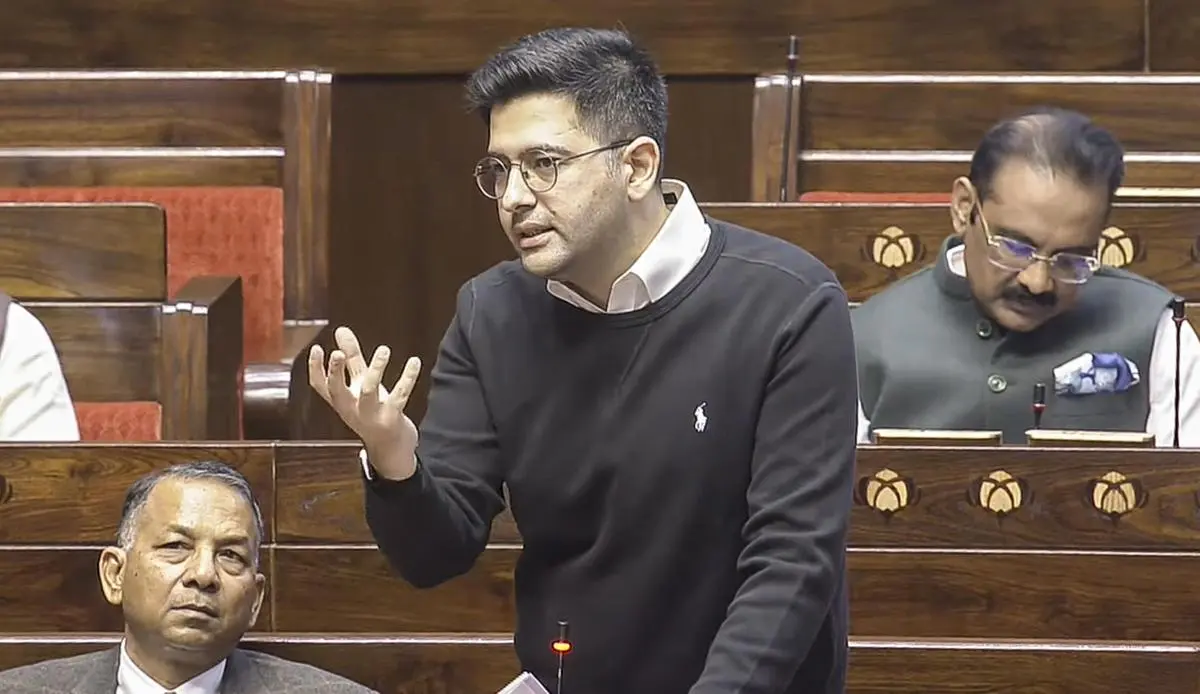
The Rajya Sabha member switched from the Aam Aadmi Party (AAP) along with six other MPs last week. The merger was later accepted by Rajya Sabha Chairman C. P. Radhakrishnan. Following this, AAP accused the departing leaders of “betrayal.”
Raghav Chadha has now publicly explained his decision to leave the party through a video shared on Instagram.
“Some people want to know the reasons behind my decision. So today’s video is for them,” he said at the beginning of the message.
Chadha said he entered politics after leaving a successful career as a Chartered Accountant and was among the founding members of AAP. He added that he devoted nearly 15 years of his “prime youth” to the party.
“I gave 15 years of my prime youth to this party. I worked with full dedication, blood, sweat and tears. But today, this is not the same party anymore. It has become a toxic work environment where you are stopped from working,” he said.
He further alleged that internal functioning within the party had changed significantly, claiming that members were restricted from speaking or working freely.
“You are stopped from speaking in Parliament,” he said, adding that decision-making was now controlled by “corrupt and compromised” individuals who, according to him, were not working in the public interest.
Chadha said he had three options: leaving politics, trying to reform the party from within, or joining another platform to continue public work.
“I felt I might be the right person, but in the wrong party,” he said, describing his decision as a collective one taken along with seven MPs who left together, including Ashok Mittal, Sandeep Pathak, Vikramjit Singh Sahney, Harbhajan Singh, Swati Maliwal, and Rajinder Gupta.
He added that people should understand his situation through a workplace analogy, saying that if an environment becomes “toxic,” it becomes difficult to function effectively.
“If your workplace becomes toxic, if you are stopped from working, if your efforts are suppressed, then what would you do?” he said.
Chadha also assured that he would continue to raise public issues even after joining the new political platform.
Chadha’s move has triggered political debate, especially ahead of upcoming elections, and comes after AAP lost several of its Rajya Sabha members, raising questions over the party’s strength in the Upper House.
The development also meets conditions under the anti-defection law, which allows a merger if at least two-thirds of a party’s legislators agree to it, which in this case was achieved by the group of seven MPs. (Agency)




Leave feedback about this