
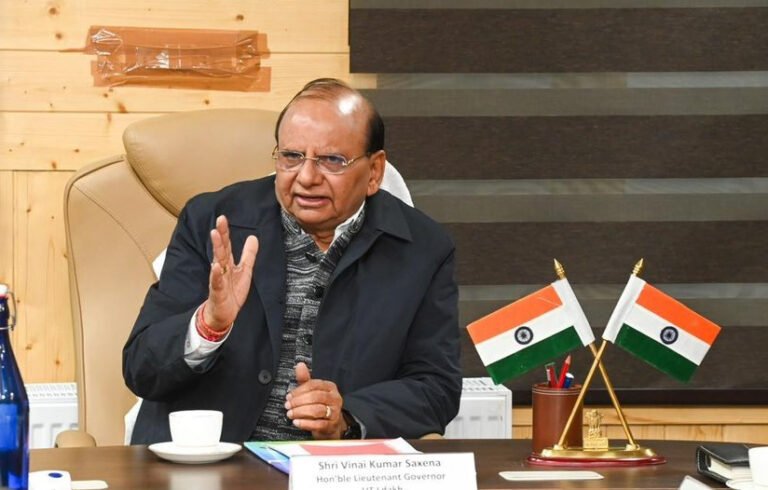
LEH/JAMMU, Apr 23: Lieutenant Governor V K Saxena on Thursday approved a series of major reforms aimed at improving ease of doing business in Ladakh’s tourism sector by deregulating the hospitality industry and reducing compliance requirements.
As part of the reforms, several documentation requirements such as character certificates, proof of minimum bank balance, and educational qualifications for tour operators have been removed. Officials said this step is expected to reduce entry barriers and improve transparency in the sector.
Under the new framework, the validity of travel agent registration has been increased from one year to five years, while the number of documents required has been reduced from seven to four.
Separate registrations for adventure and mountaineering activities have also been merged into a single unified registration covering all tourism-related activities.
In a post on X, LG Saxena said the reforms aim to give a major boost to tourism in Ladakh by creating a “streamlined, citizen-friendly registration mechanism” and reducing the compliance burden on stakeholders.
Hotel registration norms have also been rationalised. Earlier valid for five years, registrations will now include a provisional validity of 18 months, followed by a permanent registration valid for five years.
The documentation process has also been simplified, with two documents required for provisional registration and seven for permanent registration, compared to nine earlier.
The administration has introduced a single uniform category for hotel classification, replacing the earlier Category I and II system (Standard, Deluxe, Luxury).
Additionally, documents required for transfer of registration have been reduced from seven to three to further ease procedures.
For the first time, homestay registration has also been introduced in Ladakh. These registrations will be valid for five years, with provisional approval granted on two documents and permanent registration issued after mandatory training by the UT administration.
The reforms also allow cancellation and name changes—facilities that were not available earlier—requiring four documents.
Another key feature is the introduction of an online auto-renewal system, replacing the earlier manual renewal process.
Officials said the reforms are expected to strengthen the tourism ecosystem in Ladakh, expand opportunities for stakeholders, and contribute to the overall growth of the local economy. (Agency)


Leave feedback about this