
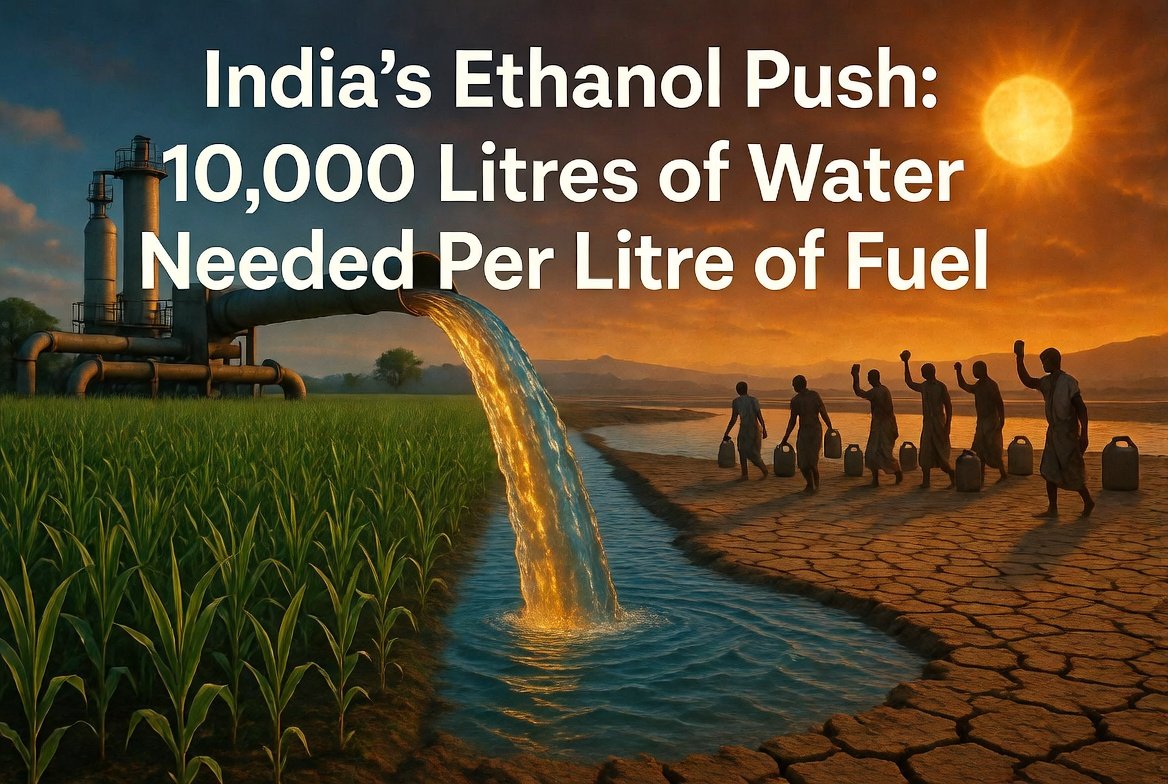
India’s push to blend ethanol with petrol, promoted as a clean energy transition, is now raising serious concerns over its impact on the country’s already stressed water resources.
At the centre of the issue are water-intensive crops such as sugarcane, maize, and rice, which are increasingly being used as raw materials for ethanol production. Experts warn that this shift could further deepen India’s water crisis.
“Ethanol blending can worsen India’s water crisis mainly because most of the raw material—sugarcane and increasingly maize—is extremely water-intensive to grow and process,” said IPCC author Anjal Prakash.
What is ethanol blending?
Ethanol blending refers to mixing ethanol, a plant-based alcohol, with petrol to reduce dependence on imported crude oil and cut carbon emissions. India has been aggressively expanding this programme in recent years, with rice also emerging as a key feedstock.
The government has allocated large quantities of rice for ethanol production, diverting it from other uses, including the public distribution system.
Massive water requirement raises alarm
Data shows the environmental cost of ethanol production is significant. Producing one litre of ethanol from rice can require around 10,790 litres of water, including irrigation needs during cultivation.
Most of this water is used during farming rather than processing. Growing rice alone demands between 3,000 to 5,000 litres of water per kilogram, while 2.5 to 3 kilograms of rice are needed to produce just one litre of ethanol.
By comparison, maize requires around 4,670 litres and sugarcane about 3,630 litres of water per litre of ethanol, highlighting the heavy water footprint of biofuel production.
Experts also warn about industrial waste. “Ethanol mills also generate large volumes of wastewater (vinasse), which can pollute surface and groundwater if not treated properly,” said Prakash.
Water crisis already deepening
India is already facing a severe water stress situation. Reports by NITI Aayog have warned that several major cities could face groundwater depletion in the coming years if current trends continue.
Despite this, ethanol production capacity is expanding rapidly, especially in water-stressed states where groundwater levels are already declining.
Sugarcane, the primary source of ethanol in India, is also highly water-intensive, further adding pressure on scarce water resources.
Experts say the contradiction is clear—while farming communities are often blamed for groundwater depletion, large-scale industrial use of the same crops for fuel is rarely scrutinised at the same level.
As India continues to push for cleaner fuel alternatives, concerns are growing that the ethanol programme may unintentionally worsen an already critical water crisis. (Agency)


Leave feedback about this